
 EN
EN



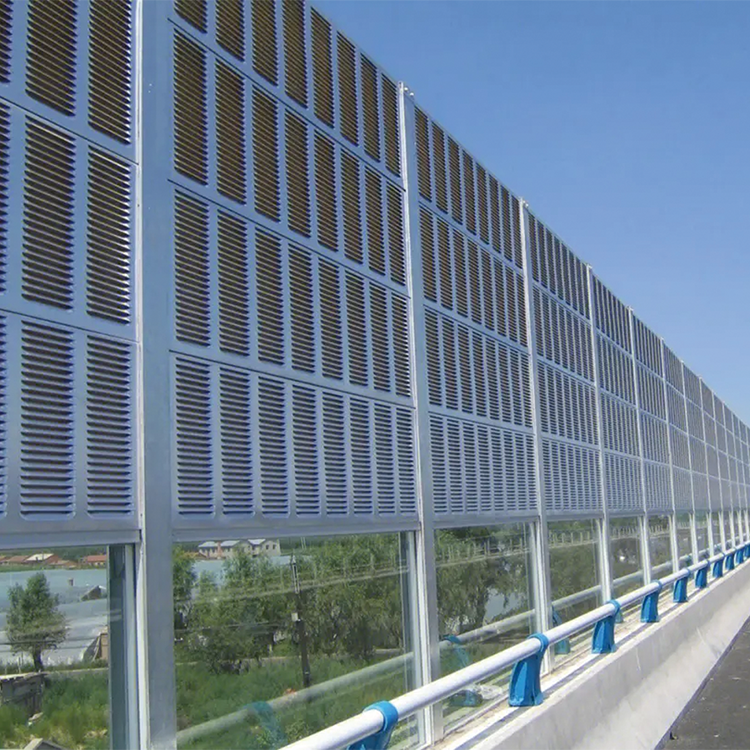
The Real Problem with Highway Noise Isn’t Volume—It’s Frequency
Highway traffic noise is rarely a single, uniform hum. Anyone who has lived near a busy interstate knows the difference between the steady drone of passenger cars and the deep, rumbling growl of heavy trucks. That low-frequency content is exactly where conventional sound barriers tend to fall short. Standard upright barriers—the tall, flat walls seen along countless highways—do a decent job blocking higher-frequency noise but struggle with the longer wavelengths that punch right through or bend over the top.
Field measurements indicate that the dominant frequency components of highway noise typically fall within 315 to 2500 Hz. As the proportion of heavy-duty vehicles increases, the low-frequency contribution becomes significantly more pronounced. This matters because low-frequency noise not only propagates more efficiently around obstacles but also overlaps with the auditory sensitivity ranges of nearby residential communities. So maximizing noise reduction isn't about throwing up the tallest wall possible—it's about understanding what the sound is actually doing and designing the barrier to intercept it at the source.
Why Barrier Height Alone Won't Get You There
There's a common assumption in transportation planning: taller barrier equals quieter neighborhood. And yes, height does matter. A 4-meter barrier in a Toronto study produced measurable noise reduction in the residential community behind it. But diminishing returns kick in fast. Once a barrier reaches a certain height—typically around the line-of-sight break between source and receiver—adding extra meters yields increasingly marginal gains.
The real leverage point is the top edge. Sound doesn't just pass through a barrier; it diffracts over the top. That's why top-edge treatments can deliver outsized improvements relative to their cost. Research using boundary element methods has shown that multi-edge tops—barriers with additional edges on either the source or receiver side—can produce relative insertion loss values that are consistently high across a wide range of parameters. A 90-degree Y-shaped top, for instance, has been found to improve insertion loss by as much as 13 dB in the 1250–2000 Hz band compared to other top configurations.
But here's the catch: not every top shape works everywhere. The same Y-top that excels in one frequency range might do very little for another. That's why design has to be frequency-aware, not just height-driven.
Absorptive vs. Reflective—When One Size Doesn't Fit All
This is where things get interesting—and where a lot of projects leave performance on the table. A reflective barrier bounces sound back toward the source side. An absorptive barrier soaks it up. Conventional wisdom says absorptive is always better. But the data tells a more nuanced story.
In a full-scale test of a 4-meter highway noise barrier in Toronto, researchers compared absorptive and reflective configurations side by side. The result? No statistically significant difference in noise reduction between the two. That's not a typo. Under single-barrier conditions with a clear line of sight and reasonable source-to-receiver geometry, the absorption coefficient of the barrier face itself doesn't always move the needle as much as expected.
But—and this is a big but—change the geometry. Add a second parallel barrier, and the picture flips. Absorptive barriers in parallel configurations can significantly reduce and even eliminate the performance degradation caused by multiple sound reflections between the two walls. A reflective barrier paired with another reflective barrier in a parallel setup? That's a recipe for a reverberant canyon that actually makes things worse in certain spots.
So the choice between absorptive and reflective isn't about which is "better." It's about understanding the site geometry and choosing accordingly.
The Diffuser Effect—Small Changes, Big Results
One of the most underrated tools in highway barrier design is the surface diffuser. These are protrusions—rectangular, angled, or otherwise—attached to the barrier face that break up the reflected wavefront. They don't just scatter sound; they change the way sound interacts with the barrier's surface across different frequencies.
Numerical simulations using acoustic finite element methods have shown that increasing the width, height, and spacing of rectangular diffusers can improve noise reduction performance, particularly around the 1000 Hz range. And when diffusers are combined with an optimized top shape, the gains stack. One study found that a composite noise barrier with additional diffusers could achieve an insertion loss up to 6 dB higher than a Y-type barrier alone.
To put that in perspective: 6 dB is roughly equivalent to halving the perceived loudness. That's not a trivial increment—that's the difference between a barrier that meets the minimum spec and one that actually solves the problem.
A Real-World Case: The Diffraction Problem on a Mountain Highway
A few years back, a design team was working on a highway section running through a narrow valley in a mountainous region. The road was flanked by residential clusters on both sides, and the existing 3.5-meter upright barriers were delivering mediocre results—about 5 to 6 dB of insertion loss at the nearest receiver positions, well short of the 10 dB target.
The initial instinct was to raise the barrier height. But geological constraints and wind-load considerations made that impractical. So the team pivoted to top-edge optimization instead. They modeled several configurations: a straight top, a T-shaped cap, and a Y-shaped top with absorptive treatment on the source-side face.
The Y-top with absorption delivered the best performance—roughly 11 dB of insertion loss at the critical 1000 Hz band, which matched the dominant frequency of the heavy truck traffic on that route. The total height increase was less than half a meter. That's the kind of outcome that changes how people think about barrier design: not as a brute-force exercise in adding height, but as a precision acoustic intervention.
What the Standards Actually Say
There's a regulatory baseline that any serious design needs to respect. According to the Chinese environmental standard HJ/T90-2004, the noise reduction coefficient of a sound absorption material used in a noise barrier should be greater than 0.5. For railway applications, the standard TB/T 3122-2005 goes further, requiring a noise reduction coefficient of no less than 0.70.
These aren't arbitrary numbers. They reflect a practical understanding of what materials actually deliver in real-world conditions. Rock wool, for example, has an NRC around 0.75—well above the threshold. But NRC alone doesn't tell the full story. A material with great absorption at 500 Hz might do almost nothing at 2000 Hz. That's why frequency-specific data matters more than a single aggregate number.
| Barrier Feature | Impact on Insertion Loss | Best Frequency Range | Key Limitation |
|---|---|---|---|
| Standard upright (reflective) | Baseline (reference) | Mid-to-high frequencies | Poor low-frequency performance |
| Y-shaped top (90°) | + up to 13 dB vs. other tops | 1250–2000 Hz | Less effective below 800 Hz |
| Absorptive face (single barrier) | Marginal improvement | Broadband | Limited benefit in single-barrier setups |
| Absorptive face (parallel barriers) | Significant—eliminates reflection degradation | Broadband | Requires dual-barrier geometry |
| Additional diffusers | + up to 6 dB vs. Y-type alone | ~1000 Hz | Performance varies with spacing and dimensions |
| Multi-edge top (symmetrical) | High, consistent IL across parameters | Wide range | Diminishing returns beyond 0.5m edge length |
The Limits of Any Single Approach
Here's the honest truth: no single design element is a magic bullet. A Y-top that delivers 13 dB of improvement in one frequency band might do very little in another. An absorptive face that works beautifully in a parallel-barrier setup could be wasted money in a standalone installation. And a diffuser configuration that performs well at 1000 Hz might not translate to a site where the dominant noise is at 500 Hz.
The key is to start with the actual noise spectrum of the site—not a generic assumption about what highway noise sounds like. Measure the source. Understand the receiver positions. Model the geometry. Then design around the data. That's not glamorous, but it works.
Manufacturers with deep fabrication capabilities and consistent quality control make a tangible difference in whether a well-designed barrier actually performs as modeled. Companies like Kanghailong, with their focus on precision manufacturing and material consistency, are the kind of partners that turn acoustic designs into field-ready solutions—because in the end, a barrier is only as good as its build quality.
Table of Contents
- The Real Problem with Highway Noise Isn’t Volume—It’s Frequency
- Why Barrier Height Alone Won't Get You There
- Absorptive vs. Reflective—When One Size Doesn't Fit All
- The Diffuser Effect—Small Changes, Big Results
- A Real-World Case: The Diffraction Problem on a Mountain Highway
- What the Standards Actually Say
- The Limits of Any Single Approach