
 EN
EN


The Hidden Risk Beneath the Tracks
Railway cuttings are not passive landscape features. They are engineered intersections where human infrastructure meets natural geology, and that meeting point is rarely stable over the long haul. A cutting—essentially a man-made channel carved through hillsides to keep track grades manageable—exposes soil and rock layers that have been resting undisturbed for millennia. Once exposed, these materials begin a slow but relentless process of weathering, swelling, contracting, and creeping downhill.
The numbers tell a sobering story. Network Rail, which manages roughly 20,000 miles of track in the UK, has identified thousands of earthwork assets—cuttings and embankments—that require ongoing monitoring and intervention. In a single project between Faversham and Dover Priory, engineers removed thousands of tonnes of earth from cutting sections to reduce slope steepness and installed rock netting to prevent debris from reaching the tracks. That was a £3 million upgrade at just six sites. Across an entire rail network, the cumulative cost of unmanaged cutting degradation runs into the hundreds of millions annually.
What Actually Happens When a Cutting Fails
Surface erosion rarely makes headlines, but it is the primary driver behind most cutting failures. Rainfall runs down the exposed slope face, carrying fine particles with it. Over time, what starts as minor rilling turns into gully formation, and shallow soil slips become inevitable. The process is insidious because it happens gradually—until one heavy storm pushes the slope past its tipping point.
Deeper failures are more dramatic. When water infiltrates through cracks and fractures in the rock mass, pore water pressure builds up. This reduces the effective stress holding the slope together. Combine that with the cyclic loading from passing trains—the vibration and ground-borne energy that travel through the ballast and into the cutting walls—and the result is a slope that is progressively losing its margin of safety.
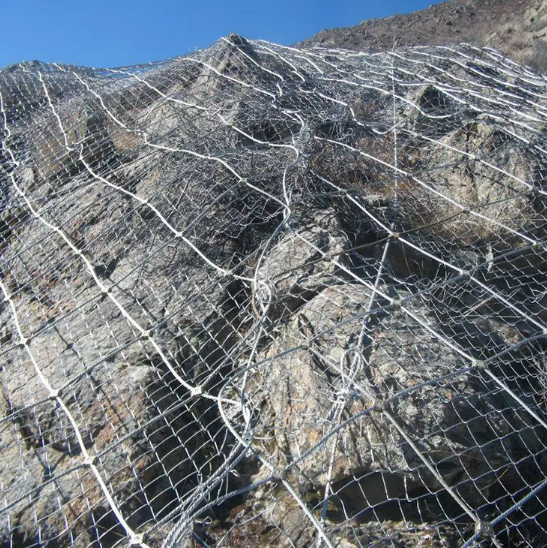
Then there is the operational reality. A single rockfall onto the track can shut down a line for hours. Derailment risks aside, the delays cascade through the entire network. In 2022, Network Rail installed temporary netting on the Newport-Gloucester line as an emergency measure. The following year, they began converting that temporary system into a permanent one, drilling nearly 4,000 holes—each four to five metres deep—to install rock bolts and rockfall netting across more than 17,500 square metres of cliff face. That is the scale of intervention required when a cutting has been left unattended for too long.
How a Slope Protection Net Interrupts the Failure Chain
A properly specified slope protection net does not just catch falling rocks. It performs three distinct functions that address different stages of the failure process.
First, surface protection nets—often made from steel wire rope or high-density geosynthetics—anchor the topsoil in place. They reduce the velocity of surface runoff, allowing rainfall to infiltrate rather than scour. This prevents the loss of fine particles that weakens the upper soil horizon. Second, rockfall netting systems catch individual rock blocks that have detached from the cutting face. These systems are designed to absorb the kinetic energy of falling debris and hold it safely against the slope until maintenance crews can remove it. Third, high-tensile netting systems integrated with rock bolts actively reinforce the slope, preventing detachment in the first place rather than just catching the consequences.
The selection of the right system depends on the failure mechanism. Shallow surface erosion calls for erosion control mats that promote vegetation establishment. Blocky rockfall hazards require steel wire rope net panels that meet international standards like BS ISO 17746:2016, which specifies the characteristics of rope net panels for railway and highway applications. Deep-seated instability demands a combination of rock bolts, netting, and sometimes soil nails or retaining walls.
| Failure Type | Primary Mechanism | Netting Solution | Typical Application |
|---|---|---|---|
| Surface erosion | Rainfall runoff, particle loss | Erosion control mat / geotextile | Shallow slopes, cuttings < 45° |
| Rockfall | Block detachment, gravity | Steel wire rope net panels | Steep cuttings, fractured rock |
| Shallow slide | Saturated soil, loss of shear strength | High-tensile netting + anchors | Moderate slopes with drainage issues |
| Deep instability | Shear plane failure, structural collapse | Rock bolts + reinforced netting + drainage | High cuttings, poor geology |
A Real-World Case: The Uphill Cutting in Somerset
Consider the Uphill cutting in Somerset, a railway feature that has challenged engineers for nearly two centuries. The cutting was originally constructed almost 180 years ago, during Brunel's era, and it has remained a persistent problem ever since. When Bam Ritchies' engineers were brought in to stabilize it, they found themselves confronting the same geological issues that had plagued the original builders. The steep slopes needed reinforcement to meet current design standards, and the solution involved a combination of slope regrading and netting installation.
What makes this case instructive is not the novelty of the engineering but the longevity of the problem. A cutting that was considered acceptable in the 1840s became a critical liability in the 21st century. The lesson is clear: slope degradation is not a one-time event but a continuous process. Intervention is not optional; it is a matter of when, not if.
The Cost of Doing Nothing
Delaying slope protection is expensive in ways that go beyond the obvious repair bills. There is the direct cost of emergency interventions, which are almost always higher than planned maintenance. There is the cost of service disruptions—replacement buses, delayed freight, lost productivity. There is the reputational cost when a rail operator is seen as unreliable. And there is the safety cost, which is impossible to quantify but impossible to ignore.
A comparison of planned versus reactive maintenance tells the story clearly:
| Approach | Typical Cost per Site | Service Impact | Risk Profile |
|---|---|---|---|
| Planned netting installation | £500,000 – £1,500,000 | Minimal (scheduled closures) | Low |
| Emergency rockfall response | £2,000,000+ | Major disruptions | High |
| Long-term neglect + major rebuild | £5,000,000+ | Extended line closure | Very high |
The economics favour early intervention. A slope protection net installed before failure occurs costs a fraction of what it takes to clean up the mess afterward. More importantly, it keeps trains running and passengers safe.
Standards and Specifications That Matter
Slope protection nets are not commodity products. They are engineered systems with defined performance criteria. The international standard BS ISO 17746:2016 provides a framework for specifying steel wire rope net panels and rolls used for retaining unstable slopes and preventing rockfalls along railways. It covers everything from wire properties and rope construction to sampling and testing protocols.
For manufacturers, compliance with these standards is not optional if the product is intended for serious infrastructure projects. Rail operators and contractors specify these standards in their tender documents, and any supplier that cannot demonstrate compliance is simply not in the running. This is where experienced manufacturers differentiate themselves—not just by meeting the standard but by understanding the engineering context in which the netting will perform.
Making the Right Choice for the Long Haul
Selecting a slope protection net for a railway cutting requires a clear understanding of the site-specific conditions. Slope angle, geology, rainfall patterns, and drainage all factor into the decision. A net that works perfectly on a dry, stable cutting in one region may fail entirely on a wet, fractured slope in another.
The most effective approach combines engineering analysis with proven products. That means working with suppliers who understand both the standards and the real-world conditions. Kanghailong, with its manufacturing footprint across multiple facilities and its experience in barrier netting solutions, represents the kind of partner that rail contractors look for when the stakes are high. The combination of technical capability, quality control, and supply chain reliability makes a meaningful difference when a cutting needs protection that will last.