
 EN
EN



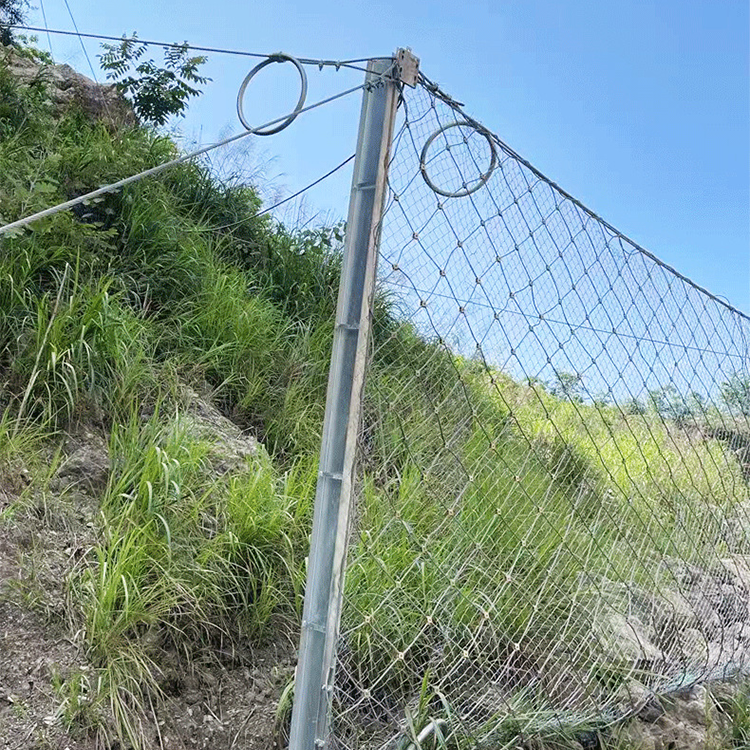
The physics of a rock in motion
A rock tumbling down a mountainside carries serious energy. A 100-kilogram boulder moving at 20 meters per second—not an extreme scenario on a steep highway cut—has about 20 kilojoules of kinetic energy. Scale that up to a one-ton block and the number jumps to 200 kJ. Highway rockfall barriers routinely handle blocks in this range, and some are designed for impacts exceeding 3,000 kJ.
The fundamental job of a slope protection net isn't to be stronger than the rock—that would require massive concrete structures. Instead, the net manages the energy through controlled deformation. When a rock strikes a properly designed flexible system, the net deflects, the support cables stretch, and energy dissipators—typically friction brakes or ring brakes—absorb the bulk of the impact force.
This is the core insight that separates flexible netting from rigid barriers. A concrete wall stops a rock by brute force, but that force has to go somewhere—into the wall, into the foundation, often into the rock itself. A flexible net lets the rock move, just not as far or as fast as it would without intervention.
Active versus passive: two ways to manage the hazard
Slope protection nets divide cleanly into active and passive systems, and each prevents rockfalls through a completely different mechanism.
Active systems get tensioned directly against the slope face. The net presses loose surface material back into place, preventing detachment in the first place. This is the more elegant solution when the geology cooperates—stop the rock from falling rather than catching it after it lets go. The tension in the net creates a normal force on the slope surface, increasing friction between rock layers and reducing the likelihood of blocks working loose.
Passive systems, by contrast, sit downhill from the hazard zone and intercept rocks already in motion. These are the catch fences and barrier nets you see along mountain highways. The net doesn't try to hold the slope together; it catches what comes down and dissipates the energy through deflection.
The choice between active and passive often comes down to site conditions and budget. Active systems cost more to install—the anchoring pattern is dense and the tensioning requires care—but they offer permanent protection with minimal maintenance. Passive systems are cheaper to install but require clearance space at the toe for debris accumulation and occasional maintenance to remove caught material.
A highway department in the Pacific Northwest faced this choice on a 3-kilometer stretch through fractured basalt. The geology showed frequent small-scale spalling but no large-block hazards. They chose active mesh with 150mm openings and 4mm wire, anchored on a 2.5-meter grid. The installation cost was higher than a passive barrier would have been, but the elimination of weekly rock-clearance crews paid for the difference within two years.
How the mesh itself stops the rock
The mesh geometry matters as much as the system configuration. Different mesh patterns handle impact forces differently.
Knitted mesh, with its interlinked loops, offers high flexibility and performs well under dynamic loads. The loops can open and close as the rock impacts, distributing stress across multiple wire segments rather than concentrating it at a single point. Woven mesh provides more uniform strength and stiffness but less give under impact. Ring nets—chainmail-like structures of linked steel rings—excel at energy absorption because each ring deforms independently, spreading the load.
Double-twist hexagonal mesh, common in gabion applications, has locked wire connections that prevent localized damage from propagating across the panel. This matters in rockfall applications because a single puncture in a welded mesh can unzip the entire panel. The double-twist construction contains the damage.
The wire diameter and mesh opening size also play critical roles. Smaller openings catch smaller rocks, but they also reduce visibility and increase wind load. Larger openings let water and small debris pass through—often beneficial for drainage—but may allow hazard-sized rocks to pass if the openings are too big. The sweet spot for most highway applications falls in the 100 to 200 mm range, with wire diameters from 3 to 5 mm depending on the energy rating required.
The role of anchoring and support structure
A slope protection net is only as good as what holds it up. The anchor pattern—spacing, depth, and type of anchor—determines whether the system performs as designed or fails at the first real test.
Active systems use a dense anchor grid, typically 2 to 3 meters spacing, with rock bolts or soil nails driven 3 to 6 meters into competent material. Anchor plates at the surface distribute the net tension across the slope face. If the anchors are too shallow or too widely spaced, the net can't maintain the tension needed to restrain surface material.
Passive barriers use fewer but heavier anchors—the posts that support the net get set deep into bedrock or massive concrete footings. The braking devices on the support cables are what actually stop the rock; the anchors just need to hold the posts in place while the system deflects. This is why passive barrier design focuses so heavily on energy ratings and deflection limits—the anchors don't absorb the energy, they just keep the system rooted while the net and brakes do the work.
| Component | Active System | Passive System |
|---|---|---|
| Anchor spacing | Dense (2–3 m) | Wide (post spacing only) |
| Anchor depth | 3–6 m into competent rock | Deep into bedrock or concrete footings |
| Primary energy dissipation | None (prevents movement) | Braking devices on support cables |
| Deflection under load | Minimal | Significant (meters, in some cases) |
| Maintenance need | Low | Periodic debris removal |
What happens when a rock hits the net
The impact sequence in a passive barrier happens fast—milliseconds from first contact to full deflection—but it follows a predictable pattern.
First contact: The rock hits the mesh panel. The mesh deflects locally, transferring load to the support cables. The ring or knitted construction allows the mesh to conform around the rock's shape, distributing contact stress rather than concentrating it.
Load transfer: The support cables carry the load to the posts and to the braking devices. The cables stretch elastically, storing some energy as strain. The brakes—friction brakes or ring brakes—begin to slip, converting kinetic energy into heat.
Full deflection: The system reaches maximum deflection, typically 1 to 3 meters for highway barriers. The rock has been slowed from its initial velocity to near zero over that distance. The energy that started as kinetic has been converted to heat in the brakes, elastic strain in the cables, and a small amount of deformation in the mesh itself.
Rebound and settlement: The system springs back partially as the elastic strain releases. The rock settles against the mesh or drops into the collection area at the toe. The barrier is ready for the next impact.
This sequence explains why flexible systems outperform rigid barriers in most rockfall scenarios. A rigid wall stops the rock abruptly, concentrating all the impact energy at a single point. A flexible net spreads the energy over time and distance, reducing peak loads on every component.
Limitations and honest assessment
No slope protection net works everywhere, and pretending otherwise does a disservice to the engineering community.
Active systems require rock that can hold anchors. In highly weathered or soil slopes, the anchors may not develop enough pullout resistance to maintain tension. Passive barriers need space—both vertical clearance for the net to deflect and horizontal space at the toe for debris accumulation. In tight corridors with limited right-of-way, a passive barrier may simply not fit.
| Limitation | Active System | Passive System |
|---|---|---|
| Anchor requirements | Good rock required | Good foundation required |
| Space needed | Minimal | Significant deflection zone + debris storage |
| Vegetation impact | Some coverage | Minimal (catchment only) |
| Visual impact | High (covers slope) | Moderate (posts visible) |
| Best avoided when | Rock too weak for anchors | No space for deflection or debris |
Drapery systems, while versatile, don't work well on slopes with large block hazards—they guide debris rather than stopping it, so a big rock can still cause damage at the toe.
The performance of any system depends heavily on installation quality. Poorly tensioned active mesh doesn't restrain; poorly anchored passive barriers deflect too far and may allow rocks over the top. This is why reputable suppliers emphasize not just product quality but also installation support and technical documentation.
For mountainous highway projects where rockfall risk is a daily operational concern, manufacturers like Kanghailong provide the engineering-grade netting systems that balance performance with practical installability. Their manufacturing footprint across multiple regions ensures consistent product quality and reliable supply for projects that can't afford delays.