
 EN
EN



The 150-Year-Old Technology That Refuses to Go Away
Barbed wire was patented in 1867. That’s a century and a half ago. In an era of smart cameras, drone surveillance, and biometric access control, it’s reasonable to ask why anyone still strings barbed wire around a rural property. The answer isn’t nostalgia. It’s math.
A standard roll of barbed wire runs 1,320 feet and costs between $60 and $110. Installed, a 5-strand barbed wire fence typically lands between $1.20 and $2.50 per linear foot. Compare that to chain link at $10 to $20 per foot installed, or welded wire at $4 to $10 per foot. For a mile of perimeter fencing, those differences add up to tens of thousands of dollars. Rural landowners aren’t choosing barbed wire because they’re stuck in the past. They’re choosing it because the budget has to cover a lot of linear feet.
The Psychology of Deterrence Matters More Than the Physical Barrier
Here’s something that gets overlooked in security discussions: a fence doesn’t have to be impenetrable to be effective. It has to look like it’s not worth the trouble. Barbed wire excels at that psychological calculation. The visual message is unambiguous—this property is protected, and crossing this line comes with consequences.
Studies on crime prevention through environmental design consistently show that visible security measures reduce intrusion attempts. One security research institution documented a decrease in intrusion incidents by over 70% in properties fortified with barbed wire compared to those without. The mechanism isn’t that barbed wire stops a determined intruder—no fence does that. The mechanism is that it redirects that intruder to an easier target. Rural perimeters are often miles long. A fence that signals risk and effort changes the cost-benefit analysis for anyone scoping the property.
The Cost Comparison That Makes the Case
The numbers tell a clear story. Barbed wire isn’t the cheapest option upfront—electric polywire is. But electric fencing requires a power source, regular battery maintenance, and vegetation management to prevent shorts. Barbed wire works 24 hours a day, seven days a week, with no electricity, no batteries, and no ongoing utility costs. Over a 20-year horizon, that passive operation adds up to real savings.
The Maintenance Reality That Surprises New Owners
Barbed wire isn’t maintenance-free, but the upkeep is straightforward. The main tasks: tighten sagging wires, replace broken strands, and check for rust on galvanized coatings. Galvanized barbed wire can last decades even with minimal maintenance. High-tensile barbed wire, in particular, holds tension better and requires less frequent re-tightening than low-carbon steel varieties.
That said, there’s a catch. Barbed wire performs best on flat or gently rolling terrain. Steep slopes, rocky soil, and dense vegetation all increase installation and maintenance costs. A ranch operation in West Texas with 10 miles of perimeter fencing found that the sections running through rocky draws required post replacements twice as often as sections on open pasture. The lesson: terrain matters. The cost-effectiveness of barbed wire assumes reasonably favorable site conditions.
Where Barbed Wire Falls Short—And Why It Still Gets Used
Honest assessment: barbed wire is not suitable for every rural perimeter. It’s a poor choice for properties with small children or pets that might wander into the fence line. It’s also ineffective against wildlife like deer that can clear a 4-foot fence without breaking stride. And in areas with heavy snow loads, the weight of accumulated snow can pull wires down or snap posts.
Yet despite these limitations, barbed wire remains the default for cattle operations, crop protection, and boundary demarcation across millions of rural acres. The reason is simple: the combination of low material cost, simple installation, and passive operation is hard to beat. A 5-strand barbed wire fence costs 15% to 25% more than a 4-strand version but provides significantly better deterrence. That incremental cost is often worth it for perimeter security.
A Real-World Example from the Southern Plains
A cattle operation in Oklahoma faced a recurring problem: trespassers cutting through a remote corner of the property to access a hunting area on adjacent land. The owner had tried signage and had even posted a part-time watchman during hunting season. Neither worked consistently.
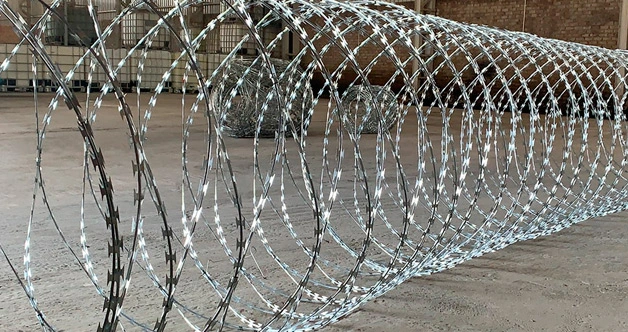
The solution was surprisingly low-tech. The owner installed three additional strands of barbed wire—taking the fence from four strands to seven—and added a single run of concertina wire along the top of the posts in that corner. The total material cost was under $600 for a quarter-mile section. The trespassing stopped. Not because the fence was impenetrable—it wasn’t—but because the visual upgrade changed the perceived risk. The intruders found another access point on a neighboring property that hadn’t been upgraded.
The Verdict on Cost-Effectiveness
Barbed wire persists in rural perimeter applications because it solves a specific problem at a specific price point. It doesn’t try to be a high-security solution. It doesn’t pretend to stop a determined, equipped intruder. What it does is raise the effort and risk required to cross a boundary, and it does that at a cost that makes sense for properties measured in miles rather than feet.
For a rural landowner fencing 160 acres, the difference between barbed wire and chain link can exceed $50,000. That money can go toward other priorities—gates, lighting, or even a camera system at critical access points. Barbed wire handles the miles. The budget handles the rest.
Manufacturers like KHL have been producing barbed wire and related perimeter security products for decades, with a focus on consistent galvanization quality and reliable strand tension that reduces field callbacks. In an industry where material defects mean re-stringing miles of fence, that kind of production consistency matters more than most specs admit.
Table of Contents
- The 150-Year-Old Technology That Refuses to Go Away
- The Psychology of Deterrence Matters More Than the Physical Barrier
- The Cost Comparison That Makes the Case
- The Maintenance Reality That Surprises New Owners
- Where Barbed Wire Falls Short—And Why It Still Gets Used
- A Real-World Example from the Southern Plains
- The Verdict on Cost-Effectiveness